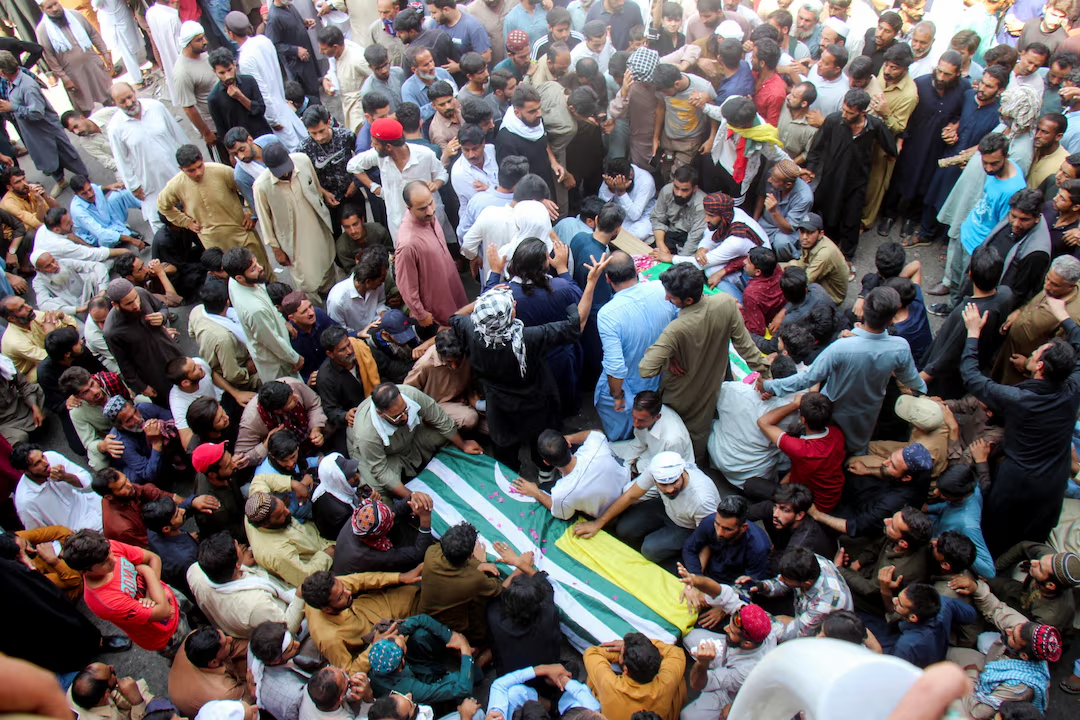
The Pakistani state’s repression has turned infinitely cruel and violent in Azad Kashmir. Protesters have been fired upon; at the time of writing this statement, there are a recorded 42 deaths associated with a movement that demands two basic rights: Haq-e-Milkiat (the right to ownership) and Haq-e-Hukumrani (the right to governance).
How did this happen?
Every Pakistani student has been taught that self-determination is the due right of the Kashmiri people; milkiat and hukumrani are two fundamental aspects of this. Pakistanis are raised with harrowing stories of Indian-occupied Kashmir (IOK), where the state blocks food and medicine from reaching Kashmiris. Open fire, curfews, and extrajudicial killings dominate the Pakistani imagination of life under Indian occupation.
So why are the same shocking scenes now emerging from the so-called Azad Jammu and Kashmir (AJK), the proverbial jugular vein of Pakistan? Today, Kashmiris in AJK too are cut off from food and medicine, while protesters are arrested, beaten, and even killed. What is the future of Pakistan if the ruling classes attack that jugular vein?
We explore this question today. A question that in essence extends beyond Kashmir to the current political scenario of the entirety of Pakistan. To understand why the Pakistani state is seen by Kashmiris as a usurper rather than a savior, we must first examine the context behind the slogans of Haq-e-Milkiat and Haq-e-Hukumrani, and how this context knocks against core ideological issues of imperialism and extraction, before panning to a broader discussion of the repression faced by peripheral regions across Pakistan.
What does AJK mean when it invokes Haq-e-Milkiat and Haq-e-Hukumrani?
Milkiat and hukumrani are essentially questions of economy and politics. Both of which are inextricably intertwined.
For the Joint Awami Action Committee (JAAC) and the people of AJK, the resources of the land belong to its people, and they should have a say in the projects carried out there. Kashmir has been subject to massive hydroelectric projects, like the Mangla Dam and the 969 MW Neelum-Jhelum Project. But there have been no formal bilateral agreements through which the people of AJK could ensure benefit from these projects. Instead, they pay the heavy toll of large-scale displacements, water scarcity, ecological damages, sewage waste problems, and reduction in downstream water.
What’s more, though these projects produce cheap hydroelectric power, the electricity tariffs for AJK are still based on disproportionately expensive fossil fuel energy. According to the Senate committee review in 2021, AJK provides 2,700 MW to Pakistan. According to JAAC, the local consumption of electricity is not more than 400 MW. Clearly, the disparity between production and consumption is not reflected in any material benefits to the Kashmiris.
Who actually benefits from these projects?
The biggest beneficiaries are two Chinese companies; the China Gezhouba Group Corporation (CGGC) gains from the 700 MW Azad Pattan Project, and the China Three Gorges (CTG) from the 720 MW Karot Hydropower Project. Other multinationals and Pakistani companies also profit off various other smaller projects. This is similar to how the imperialist capitalist class receives resources in Balochistan while the local capitalist class makes their money by acting as the junior partner to imperialists and foreign corporations. The JAAC and the people of Kashmir challenge this imposition, and demand Haq-e-Milkiat over their resources.
As for hukumrani, the legislative assembly of AJK comprises 45 seats. Out of those, 33 seats represent constituents within Kashmir. The remaining 12 seats are reserved for those people who migrated from IOK and settled all across Pakistan. So, 3.8 million registered voters in Kashmir only have 33 seats, while a total of 439,000 migrants have 12 seats reserved despite no concrete links to AJK. Since migration, this part of the population has resided in different, scattered parts of Pakistan, and cannot possibly represent the interests of AJK. This is precisely the argument of JAAC, who also stress that there is no example of such a practice in a democratic world.
For JAAC, those 12 seats have weight. Through them, the Pakistani state has an outsized control over Kashmiri politics, which has now been reduced to a symbolic rubber stamp. JAAC cites the current situation where the local authorities cannot even negotiate with its own people without approval of the Pakistani state. JAAC has thus proposed that instead of these 12 seats, these migrants may be given four seats in the Kashmir Council, which under the authority of Pakistan’s PM manages the federal affairs pertaining to Kashmir.
The truth is that economy and politics cannot be seen in isolation. Haq-e-Milkiat is directly related to Haq-e-Hukumrani. Without the latter, it is impossible to have any say in the former.
What are the core ideological issues that block the Kashmiris from milkiat and hukumrani?
The regions that came to constitute Pakistan today were subject to the control of colonial imperialist capital well before 1947. That control never ended, even after these territories were declared independent. Pakistan, like many post-colonial states, was transferred from the grip of British imperialism to US imperialism and was subsequently included within the Baghdad, SEATO, and CENTO pacts.
From that time to the present date, Pakistan has remained within the complete grip of the imperialist powers. Its ruling classes, both capitalist and feudal, act as appendages of the imperialist masters. As the competition between Chinese and US capital has sharpened in recent history, along with the impending crisis of the imperialist system –starting from the mortgage crisis of 2008 and intensifying during COVID– so have risen stringent austerity measures and the super-exploitation of colonized peripheral countries, including Pakistan.
Natural resources have particularly become an economic battlefield between the US and China. A close look into the political crisis of Pakistan reveals how the exploitation of natural resources results in state repression alongside erupting nationalist movements in the peripheral areas of Pakistan. Gwadar Port, CPEC and Riqo Dik are major sites of extractive exploitation in Balochistan; corporate farming, canals and the Thar Coal Project are similarly causing severe resentment in Sindh. Recent instability in Khyber Pakhtunkhwa can be attributed to many underlying political issues and the state’s mistreatment, but one core reason is the agreements between US and Pakistan to extract the region’s minerals.
Alongside imperialist capital, there exists what we call bureaucratic capital: the capital controlled by the state apparatus and its bureaucratic-military elite. As imperialist capital expands within Pakistan, these local forms of bureaucratic and military capital expand rapidly alongside it, generating an intensifying drive to accumulate resources. This accumulation is concentrated in the peripheries, where the vast majority of the country’s resources are located; these regions consequently become sites of intense exploitation for both imperialist and bureaucratic capital.
It is in this light that we understand Kashmir, where the expansion of bureaucratic and military capital produces sharp disparities for the people of the region. From Balochistan to Bari Imam to Kashmir, the Pakistani military is shooting at civilians. State violence in Kashmir exists within a broader pattern of repression where the state governs territories in response to the resources they offer – either as sites of extraction, accumulation or facilitation of flows of capital. When the people living in these territories make claims to their land or demand a say in their governance, the state responds with brutality.
Kashmir is one of the most militarized and occupied regions in South Asia. It is where the two hydraulic states of India and Pakistan derive the legitimacy to govern the rest of their territories through control of water. Irrespective of how the Pakistani state may position itself in arenas of International diplomacy as a champion of Kashmiri rights, ultimately, the state does not care about what Kashmiri people want.
Hydropower projects such as the Mangla Dam and the Neelam-Jhelum Projects have created extreme precarity; according to Kashmiri political groups, these hydropower projects have made Mirpur more susceptible to earthquakes, have caused water shortages in Muzaffarabad, have displaced scores of Kashmiri from their ancestral lands without monetary compensation or recompensing land ownership where they have been settled.
We ask: what are the people of Pakistan supposed to do when their lands and resources are stolen from them for the sake of ‘development,’ for the expansion of the state, to fill the pockets of developer mafias and our bureaucratic and military establishments?
What are the avenues to ask for political reform when most protests either end with abductions or extrajudicial killings?
Why is the Pakistani state unwilling to enter a social contract with its people that is subject to principles of democracy and equity?
The only contracts our state enters are with forms of capital that either deepen its pockets or expand its reach.
It is only natural, then, that the people of these regions resist. This uneven development is precisely what gives rise to movements for national autonomy and national liberation. Such movements should therefore be understood against the backdrop of these internal contradictions, rather than dismissed as foreign conspiracies –a framing that serves only to justify violence against them. That violence, in turn, further intensifies genuine feelings of national oppression, feelings that are themselves the product of the same internal contradictions.
Connecting Kashmir to Karachi: From peripheries to capitalist centers
The same powers using the peripheral areas of the country for resource extraction and causing uneven development in the process are using the city centers as sites of investment. Pakistan, like many other dependent economies, has a very small industry. Even that industry is at the lowest strata of the global value chains of production. Production is for the sake of imperialist capital, where the bulk of the value/profit is secured by multinational companies and local companies get meagre value despite superexploitation of their workers. This value is not enough to expand the industry. That is why major investments are usually in the construction and real estate sector; hence the housing schemes, mushrooming of builder projects and over-emphasis on mega-projects.
However, the value/profit made through the industrial sector pales to insignificance next to what imperialist capital makes as it brokers the looting of natural resources. After all, where is all that value extracted from Kashmir and the other peripheries going? It, along with loans from the World Bank, Asian Development Bank, and others, is the bulk of the investment pouring into mega projects, malls, and large housing cities like DHA and Bahria. These investments are the driving force of the development fetish responsible for the large-scale evictions we are witnessing in Karachi, Islamabad, and Lahore. Here, we also need to keep in mind that the FWO and NLC were primarily involved in large-scale projects under CPEC before they entered projects like nullah cleaning and now the BRT Red Line at University Road in Karachi.
What must be done, in the core and the peripheries?
Movements are erupting in the peripheries: the BYC in Balochistan, the PTM from KP, the Anti-Canal Movement in Sindh, the Action Committees of Kashmir and GB. But there is a distinct lack of strong movements emerging from the city centers and Punjab. A key reason is the class character of the politics; primarily middle-class, it is bound to refrain from a radical form of politics. Middle-class politics is also prone to patriotism, and is thus skeptical of movements with a national identity.
While the peripheries need to orient towards a proletarian world outlook to further radicalize and unite their movements, the left-wing politics of the big cities and Punjab need to do so all the more if they want to be relevant politically. It is the radical politics of the center that must be pivotal points for the movements in the peripheries if we are to see any significant political change in the country.
To conclude, the Kashmiri demands as uniting calls to action
Why are Kashmiris being killed? Why is the same Pakistani population, enjoined upon to celebrate Kashmir Day on 5th February every year, not allowed to to show solidarity with the demands of the Kashmiris, to the point of facing arrests, FIRs and disappearances over protests?
Because they are demanding an end to the privileges, powers, special treatment and perks enjoyed by the few, while the rest of the population is crushed under the pressure of inflation and a double taxation system. Because they are demanding basic healthcare, a functioning education system, access to employment through a merit-based system so that corruption and nepotism do not rule the system.
Because they are demanding rights for laborers, peasants, pensioners and the press, and a justice system that serves the masses. Because they are asking for clean water, electricity and compensation against the resources being extracted from their region. Because they are demanding the enforcement of a genuine democratic system that ensures true representation, instead of a quota system that strips Kashmiris of their decision-making powers.
This is the complete list of JAAC’s demands, revolving around milkiat and hukumrani. They connect: to oppressed nationalities all over the country suffering from imperialist resource extraction, to peasants facing extreme poverty and hunger, to farmers experiencing water shortage and agricultural crisis, to the working class and urban poor neighbourhood of Karachi. The forces and capital behind all this misery, displacement, inflation, hunger and unemployment are the same. Under such a scenario, it is not a moral question, but a question of survival for these disenfranchised, within the peripheries and the core, to stand for each other and unite against the common enemy.
1. Abolition of privileges of ruling elites
2. End to the perks of ministers, advisors, and MLAs
3. Elimination of VIP culture
4. Reduction in unnecessary government expenditures
5. Accountability of corrupt officials
6. Justice in resource distribution
7. End to double taxation system
8. Subsidy on flour, electricity, and essential items
9. Elimination of load-shedding
10. Affordable healthcare facilities
11. Free quality education for all
12. Employment opportunities for youth
13. Transparent merit-based recruitment
14. End of political interference in institutions
15. Agricultural reforms for farmers
16. Fair water distribution
17. Fair share of Azad Kashmir’s resources
18. End to elite land grabbing
19. Protection of forests and natural resources
20. Affordable housing for low-income families
21. Women empowerment and rights
22. Child protection laws implementation
23. Labor rights and minimum wage enforcement
24. Pension reforms for retired employees
25. Local government empowerment
26. Freedom of press and expression
27. Justice and speedy trial system
28. Fair treatment of overseas Kashmiris
29. Transparency in development projects
30. Fair compensation for dam-affected people
31. Road and infrastructure development
32. Public transport system improvement
33. Clean water supply for all
34. Digital transformation and IT education
35. Promotion of tourism and culture
36. Fair electricity billing system
37. Equal opportunities without discrimination
38. Strong accountability system against misuse of power